
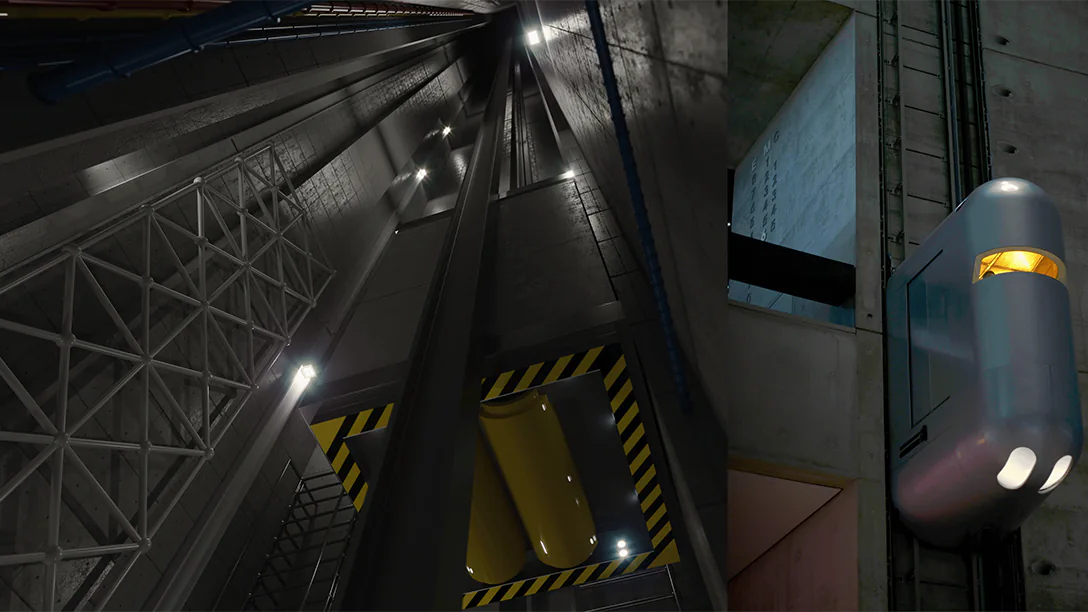
From a Simple Box to Smart Mobility: The Technological Evolution of Elevators
Over the past century and a half, the elevator has evolved from a simple lifting mechanism into a complex, high-tech transportation system. Today, elevators are equipped with artificial intelligence, energy-saving technologies, and passenger-flow optimization algorithms. Let’s take a look at the key technological breakthroughs that have permanently transformed the elevator industry.
Space and Energy Efficiency: MRL Technology
Until the end of the 20th century, most elevators required a dedicated machine room on the building’s roof to house the motor and control panel. In the 1990s, the Finnish company KONE revolutionized the industry by introducing the first MRL (Machine-Room-Less) elevator. Thanks to a compact and powerful motor, all core mechanisms are installed directly in the upper part of the shaft. This technology gave architects greater design freedom and enabled developers to save valuable building space. At the same time, modern MRL elevators are significantly more energy-efficient.
Passenger Flow Optimization: Destination Control Systems
In high-rise office buildings, long queues at elevators during peak hours were a common challenge. To address this issue, the Swiss company Schindler developed the Destination Control System. With this technology, passengers select their destination floor on a dedicated panel outside the elevator. The system analyzes all requests, groups passengers by destination floors, and then indicates which elevator they should take. This reduces the number of stops, saves time, and ensures optimal passenger flow management.
Predictive Maintenance: Artificial Intelligence Preventing Failures
Imagine an elevator that alerts you to a potential malfunction before it actually happens. This is the concept behind predictive maintenance, which is based on artificial intelligence (AI) and the Internet of Things (IoT). IoT sensors installed on critical elevator components—such as the motor and doors—continuously collect and analyze data on vibration, temperature, door operation speed, and cycle counts. An AI platform detects even the smallest anomalies that precede a failure and automatically notifies the technical service team. This transforms maintenance from a reactive process into a proactive one.
Conclusion
Technological evolution continues, making elevators smarter, faster, and more efficient. Elteg closely follows the latest developments in the industry and offers its clients the most modern, safe, and efficient solutions, tailored to the specific requirements of any project.